
 Call Now
- September 12, 2026
Parents have a difficult time picking the best preschool programme because the terminology is not standard across schools. Terms such as Playgroup, Nursery, Kindergarten 1 and Kindergarten 2 describe different levels in preschool education. In fact, each programme builds on the previous one to develop some skills from the programmes prior to it.
Preschool programmes not only help children prepare for schooling but also develop various abilities and skills such as communication, coordination, creativity skills, emotional health, socialisation and independence skills. If parents understand what each programme is about, they will be able to find the best requirements for starting preschool education for their children.
Why Are Preschool Programmes Divided By Age?
Young children develop very fast but a two-year-old child is different from the five-year-old child in terms of capabilities of development and their needs. Preschool programmes are divided in different stages according to age to ensure that the process will be organized by teachers appropriately.
Age is very important to consider but it should not be the only measure that parents will use. There are many factors to consider such as communication skills, emotional state of the child, independence, previous learning experiences.
What Is Playgroup?
A playgroup is typically the child’s first organized educational experience beyond the home. It is primarily suitable for children of the age group from about two years to three years, though some schools could have different requirements for children.
The main objective that is aimed for children through playgroup is the acclimatization of children with an educational environment. Learning takes place through interacting with others and a variety of games.
A playgroup programme may support:
- Separation from parents for short periods
- Communication of basic needs
- Interaction with teachers and other children
- Fine and gross motor development
- Recognition of colours, shapes and familiar objects
- Following simple instructions
- Participation in short group activities
Formal academic expectations should remain limited at this stage. Children need time to explore, develop trust and become familiar with a daily routine.
What Is Nursery School?
The nursery school is typically preceded by a playgroup and is aimed at children aged three to four years. This educational institution provides organized activities but retains play as the main learning method.
During the nursery school, kids can begin to learn basic literacy and numeracy by means of picture books, phonics, nursery rhymes, counting, matching, sorting and pattern activities.
Nursery school helps children develop:
- A wider vocabulary
- Better listening skills
- Enhanced independence
- The first recognition of letters and numbers
- Sharing and taking turns
- Better hand movements
- Confidence in the classroom
Many creative exercises, outdoor games, and storytelling are important, as little children learn easier through participating in activities.
What Is Kindergarten 1?
Students enrolled in Kindergarten 1, also called KG1, are usually in the age group of four to five years. The purpose of KG1 is to strengthen the skills gained at the levels of Playgroup and Nursery and get children ready for further education in the future.
The KG1 curriculum may include teaching letter sounds, basic writing, numbers, shapes, patterns, and the environment. However, these lessons should always be done in a child-appropriate way and not by just learning information.
KG1 education may cover the following areas of development:
- Recognition of letters and phonics
- Vocabulary and sentence formation
- Number recognition and counting
- Pre-writing and drawing skills
- Logical reasoning and problem-solving
- Creativity
- Teamwork
- Responsibility
Student learn how to organize things, perform simple assignments, and express their thoughts more clearly.
What Is Kindergarten 2?
Kindergarten 2, commonly referred to as KG2, is typically intended as the last stage of preschool education before moving on to elementary school. The ideal age for children in this stage of education falls between five and six years.
KG2 is intended to teach school readiness skills in a way that avoids putting too much stress on the child. Children may practice reading simple words and short phrases, write letters and short sentences, understand simple operations with numbers, and give responses to complex commands.
A typical KG2 program may include:
- Developing early reading and comprehension skills
- Improving writing abilities
- Learning basic math concepts (addition and subtraction)
- Staying focused for longer periods of time
- Completing easy tasks independently
- Improving verbal communication skills
- Learning to cooperate and solve conflicts
- Adapting to the rhythm of school life
One must keep in mind that it is not right to impose undue pressure on the child; playing, moving around, telling tales, painting and exploring should still be the possibilities for children.
How the Four Programmes Connect
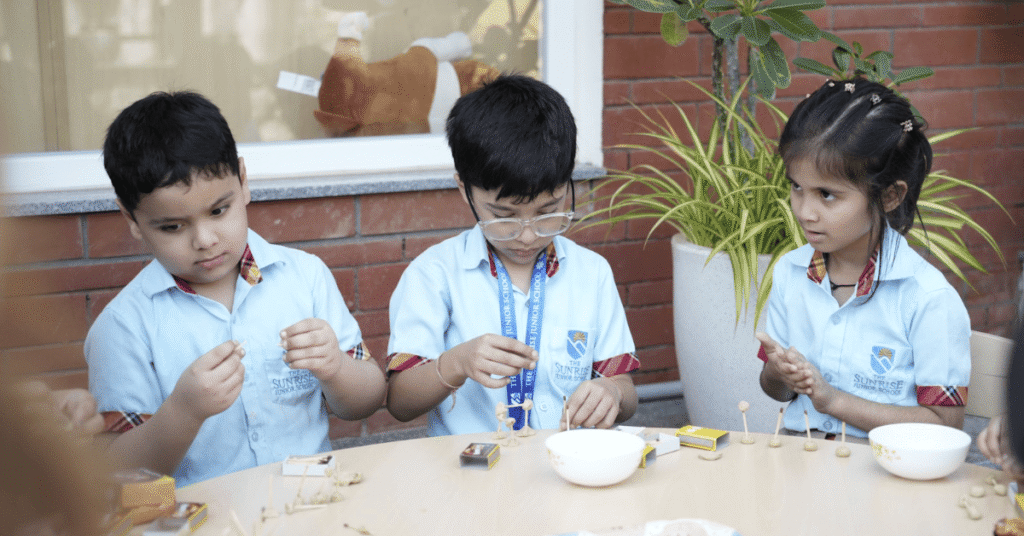
These Preschool Programs are connected stages rather than completely separate systems. Each programme gradually expands the child’s abilities:
- Playgroup supports adjustment, exploration and basic communication.
- Nursery develops early concepts, routines and social confidence.
- Kindergarten 1 strengthens literacy, numeracy and independent thinking.
- Kindergarten 2 develops school readiness and prepares children for primary education.
Progression should feel gradual. Children should receive challenges appropriate to their age while being given enough time and support to learn comfortably.
Choosing the Right Programme
Parents should begin by checking the school’s age criteria. However, they should also consider whether the child can communicate basic needs, follow simple instructions, participate in short activities and manage temporary separation from parents.
When comparing early years programmes, parents should ask about:
- Teaching methods
- Daily routines
- Class sizes
- Indoor and outdoor play
- Language development
- Teacher-child interaction
- Safety and hygiene
- Progress assessment
- Communication with parents
A suitable programme should recognise that children develop at different speeds.
The Sunrise Junior School located in Dehradun is offering programs for Playgroup, Nursery, Kindergarten 1 and Kindergarten 2. The focus of learning at this school is on guided play, investigation and important life experiences.
How Parents Can Support Progress at Home
Parents can foster preschool learning by doing simple day to day things. Reading stories, counting things at home, talking about colors, drawing, singing and performing various tasks by themselves can enhance the experience obtained at school.
Learning at home should be fun and exciting. Too many printings or comparing one child to another may cause the loss of self-confidence. Keeping in touch with the teachers allows parents to keep track of the child’s development.
Conclusion
Playgroup, Nursery, Kindergarten 1 and Kindergarten 2 serve different developmental purposes. Together, they provide a gradual journey from a child’s first group-learning experience to readiness for primary school.
The proper program must be suitable for the child’s age, skills, and emotional preparedness. Parents searching for preschools in Dehradoon should pay attention to the learning process, security, teaching methods, support offered, etc.
Frequently Asked Questions
Usually, playgroup is for children aged two or three years, although it may vary according to some criteria set by different schools.
At nursery level, children get acquainted with language, literacy, numeracy, physical training, creativity, and social behaviors through various games and activities.
Whereas Kindergarten 1 focuses on basic prerequisites in literacy and numeracy, Kindergarten 2 reinforces those abilities and lays the groundwork for primary education.
There might still be a possibility of being admitted to preschool depending on how old the child is and how well prepared he/she is. Parents should share details of their child’s past with the preschool.
What programme is suitable for the child depends on the age, ability to communicate, independence and emotional readiness. Parents have to find out about the school’s evaluation procedures.

